Change My Mind: Persuasive Strategies说服我:三大说服策略
想改变别人的想法?靠的是三种经典说服策略:可信度(ethos)、逻辑(logos)与情感(pathos)。Want to change someone's mind? You rely on three classic persuasive strategies: credibility (ethos), logic (logos), and emotion (pathos).
学习目标 · Learning Goals
- 1Generate and develop ideas for a specific purpose.围绕特定目的生成并发展想法。
- 2Identify and explain how ethos, logos, and pathos are used and why.辨识并解释 ethos、logos、pathos 如何被运用以及为何有效。
What It Means to Persuade 什么是说服
There are three main persuasive strategies that you can use to more effectively influence audience members' beliefs, attitudes, and values. They are ethos, logos, and pathos.
To persuadepersuade 说服:影响目标受众对某主题的看法,改变或强化其观点。 is to influence your target audience's view on a certain subject, whether that means changing their opinion completely or simply strengthening an already existing view. To accomplish this, 3 main persuasive strategies (historically called rhetorical appealsrhetorical appeals 修辞诉求:古典修辞学中说服受众的三种途径:ethos、logos、pathos。) are used: ethos, logos, and pathos.
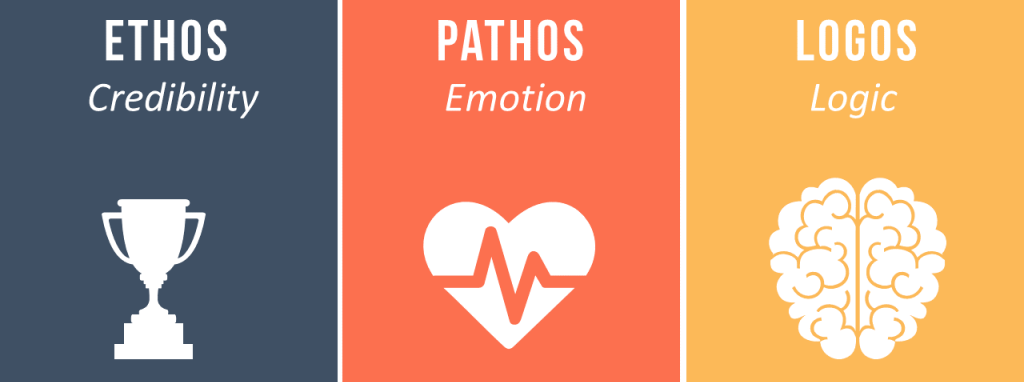
想要更有效地影响受众的信念、态度与价值观,你可以使用三种主要的说服策略:ethos(人品诉求)、logos(逻辑诉求)、pathos(情感诉求)。
所谓“说服”,就是影响目标受众对某个主题的看法——可以是彻底改变他们的观点,也可以只是强化他们已有的立场。要做到这一点,人们使用三种主要的说服策略(历史上被称为修辞诉求 rhetorical appeals):ethos、logos、pathos。
Ethos: Getting the Audience to Trust You Ethos:让受众信任你
Ethos refers to your ability to get the audience to trust you, and includes three dimensions: competencecompetence 能力(感知专业度):受众对说话者/作者在该主题上专业程度的感知。, trustworthinesstrustworthiness 可信:受众感到信息准确、可信且非操纵性的程度(即使实际上在操纵)。, and dynamismdynamism 活力:说话者外向、有感染力,或作者读来有趣的程度。.
Competence refers to the audience's perception of the speaker or writer's expertise in relation to the topic being discussed. A speaker can enhance their perceived competence by presenting a speech based in fact and that is well organized and practiced. Competent speakers must also know the content of their speech and be able to effectively deliver that content. Relevant personal stories are also a large part of accomplishing ethos in many cases, as if your audience believes you have "gone through it" yourself, they are more inclined to believe your perspective is valid and representative of reality.
Trustworthiness refers to the degree that an audience perceives a speaker or writer to be presenting accurate, credible information in a non-manipulative way - even when they are using manipulative tactics! Perceptions of trustworthiness come from a combination of the content of the speech and the personality of the speaker. In terms of content, trustworthy speakers consider the audience throughout the speech-making process, present information in a balanced way, do not obviously try to coerce the audience, even though they may subtly employ propagandistic techniques. In terms of personality, trustworthy speakers are usually friendly and warm - in short, they want their audience to like them and want to listen to them.
Dynamism refers to the degree to which audience members perceive a speaker to be outgoing and animated, or a writer interesting to read. Two components of dynamism are charismacharisma 魅力:使说话者吸引受众的抽象与具体特质的混合,难以刻意培养。 and energy. Charisma refers to a mixture of abstract and concrete qualities that make a speaker attractive to an audience. This includes elements such as expressive body language, eye contact, active listening skills, a friendly and open demeanour, and other hard to quantify elements. Charisma comes more naturally to some people than others - many actors and politicians, for example, are naturally charismatic, which is one reason why they become actors and politicians! Unfortunately, charisma is difficult to intentionally develop, and some people seem to have a naturally charismatic personality, while others do not.
Even though everyone can't embody the charismatic aspect of dynamism, the other component of dynamism, energy, is something that everyone can tap into. Communicating enthusiasm for your topic and audience by presenting relevant content and using engaging delivery strategies such as vocal variety and purposefully making eye contact can increase your dynamism. In writing, energy refers to the use of precise and vivid language to "paint a picture" of what you want your audience to imagine or feel. The goal is to get your audience to feel what you feel about a topic, so they will share your opinion, and that means grabbing and keeping their attention with effective word choice.
Ethos 指的是你让受众信任你的能力,包含三个维度:能力(competence)、可信(trustworthiness)、活力(dynamism)。
能力(Competence)指受众如何看待说话者或作者在所讨论主题上的专业程度。说话者可以通过呈现基于事实、组织良好、经过演练的演讲来提升被感知到的能力。有能力的说话者必须熟知演讲内容,并能有效地传达。在很多情况下,相关的个人经历也是建立 ethos 的重要部分——如果受众相信你“亲身经历过”,他们就更倾向于认为你的观点是有效且贴近现实的。
可信(Trustworthiness)指受众在多大程度上认为说话者或作者是在以不操纵的方式呈现准确、可信的信息——哪怕他们其实正在使用操纵手段!可信感来自演讲内容与说话者个性的结合。在内容上,可信的说话者在整个准备过程中都顾及受众,以平衡的方式呈现信息,不明显地强迫受众,即使他们可能暗中使用宣传式技巧。在个性上,可信的说话者通常友善温暖——简而言之,他们希望受众喜欢自己、愿意听自己说话。
活力(Dynamism)指受众感觉说话者外向、有感染力,或感觉作者读起来有趣的程度。活力有两个组成部分:魅力(charisma)与能量(energy)。魅力是一系列抽象与具体特质的混合,使说话者对受众有吸引力,包括富有表现力的肢体语言、眼神交流、积极倾听的能力、友好开放的姿态等难以量化的元素。魅力对某些人来说更与生俱来——例如许多演员和政客天生有魅力,这也是他们成为演员和政客的原因之一!遗憾的是,魅力很难刻意培养,有些人天生具备,有些人则没有。
尽管不是每个人都能拥有活力中“魅力”的一面,但活力的另一组成部分——能量(energy)——是每个人都能调动的。通过呈现相关内容、运用引人入胜的表达技巧(如声音的变化、有意识地进行眼神交流)来传达你对主题和受众的热情,就能增强你的活力。在写作中,能量指使用精准、生动的语言来“描绘”你希望受众想象或感受到的画面。目标是让受众感受到你对某话题的感受,从而认同你的观点——这意味着要用有效的措辞抓住并保持他们的注意力。
Logos: The Reasoning of an Argument Logos:论证的逻辑
Logos refers to the reasoning or logic of an argument. Speakers employ logoslogos 逻辑诉求:论证的推理与逻辑,依赖可核实、具体、客观的证据。 in a number of ways:
- Presenting specific, credible information as supporting material, citing as needed
- Explaining cause-effectcause-effect 因果关系:“如果 x,则 y”的推理结构,是 logos 的常见手法。 relationships and realistic hypothetical scenarios (i.e., "If x were to happen, then y would be the result. Therefore...")
- Carefully choosing supporting material that is verifiable, specific, and unbiased
- Using objective, precise language without "buzzwords" or exaggeration
Research shows that messages are more persuasive when arguments and their importance are made explicit.
Logos 指的是论证的推理或逻辑。说话者通过多种方式运用 logos:
- 呈现具体、可信的信息作为支撑材料,必要时注明出处
- 解释因果关系和现实的假设情景(即“如果发生 x,那么结果会是 y。因此……”)
- 谨慎选择可核实、具体、无偏见的支撑材料
- 使用客观、精准的语言,不用“流行词(buzzwords)”或夸张
研究表明,当论点及其重要性被明确表达时,信息更具说服力。
Achieving Ethos and Logos Without Research 无法查资料时如何实现 Ethos 与 Logos
Tips for Including Logos and Ethos When You Can't Do Research
Achieving strong ethos and logos can be tricky without being able to do external research and referencing, like you will be doing in your upcoming SummativeSummative 总结性评估:本节末的大型评估任务,要求做外部调研与引用。 at the end of this section, but it is completely achievable. Here are some ideas and examples for how to achieve ethos and logos relying only on yourself and what you already know:
- Logos can be achieved by explaining a realistic cause/effect situation: if x were to happen, it is likely that y would result, which is good/bad because of z. While you can use a very specific example through cited, credible research, it can also be achieved by using everyday examples that many people commonly experience, or by using famous examples that your target audience can be reasonably expected to already know (this is called common knowledge). These kinds of examples don't have to be cited.
- Schools should mandate uniforms because: Nobody can be bullied because they have inferior clothes -> improves the mental health and status of poorer students. (This is logos because it's very clinical and shows a clear and reasonable cause/effect.)
- OSSD students should have to pass the literacy test in order to graduate because: Doing so ensures everyone in society can read and write -> these skills are necessary for basically all jobs, so everyone having them means a wider pool of employable citizens, which creates a more prosperous society. (This is logos because your target audience should know what the literacy test is.)
- Ethos can be achieved, depending on the topic, by using your own relevant personal experiences, the real experiences of people close to you (a parent, an uncle, a sibling, a friend, etc.), or famous examples that your target audience should already know.
- Schools should mandate uniforms because: I wore a uniform in elementary school -> I didn't have to worry about picking out my clothes in the morning -> mornings were much less stressful for me. (This is ethos because it connects to the writer's real, relevant, representative experience.)
- OSSD students should have to pass the literacy test because: My grandfather never learned to read or write -> when my father was growing up, my grandfather couldn't help him with his schoolwork -> my father struggled in school, which demonstrates the multi-generational negative consequences of illiteracy. (This is ethos because it tells a real story of the speaker's actual family.)
For either of these, don't just say "I read in news...", "I read once on the internet that...", "studies have found...", and other similarly vague references. There are two reasons: 1. It's uncited evidence, which is plagiarismplagiarism 抄袭:使用未标注出处的证据/他人内容,属学术诚信违规。 and could earn you an ACVACV 学术诚信违规:Academic Conduct Violation,因抄袭等行为受到的处分。; 2. Even outside of an academic context, these types of phrases sound like you're inventing a fake, unverifiable source just to make yourself sound more credible. This makes you sound like a liar with no actual proof!
当你无法查资料时,如何运用 Logos 与 Ethos
在不能做外部调研和引用的情况下(本节末的总结性评估 Summative 则要求你这样做),要实现有力的 ethos 和 logos 可能有点棘手,但完全可以做到。以下是一些只依靠你自己和已有知识来实现 ethos 和 logos 的思路与示例:
- Logos 可以通过解释一个现实的因果情景来实现:如果发生 x,很可能导致 y,而 y 因为 z 而是好/坏的。你可以用经过引用的可信研究举出非常具体的例子,也可以用许多人都常经历的日常例子,或用目标受众可被合理预期已知道的著名例子(这叫常识 common knowledge)。这类例子无需标注出处。
- 学校应强制校服,因为: 没人会因为衣着差而被霸凌 → 改善较贫困学生的心理健康与地位。(这是 logos,因为它非常理性,展示了清晰合理的因果。)
- OSSD 学生应通过读写测试才能毕业,因为: 这能确保社会上每个人都会读写 → 这些技能几乎是所有工作所必需的,人人具备意味着更大的可雇佣人才库,从而创造更繁荣的社会。(这是 logos,因为目标受众应该知道读写测试是什么。)
- Ethos 视主题而定,可以通过运用你自己的相关亲身经历、身边人的真实经历(父母、叔伯、兄弟姐妹、朋友等),或目标受众应已知道的著名例子来实现。
- 学校应强制校服,因为: 我小学时穿校服 → 早上不用操心挑衣服 → 早晨压力小很多。(这是 ethos,因为它连接到作者真实、相关、有代表性的经历。)
- OSSD 学生应通过读写测试,因为: 我祖父从未学过读写 → 父亲成长时祖父无法辅导他功课 → 父亲因此在学校吃力,这体现了文盲跨代的负面影响。(这是 ethos,因为它讲述了说话者真实家庭的故事。)
无论哪种,都不要只是说“我在新闻里看到……”“我曾在网上读到……”“研究发现……”等类似模糊的说法。原因有二: 1. 这是未标注出处的证据,属于抄袭(plagiarism),可能招致 ACV(学术诚信违规); 2. 即使在学术语境之外,这类说法听起来也像是你在编造一个无法核实的假来源,只为让自己显得更可信。这会让你听起来像个没有真凭实据的骗子!
Pathos: Emotional Appeals Pathos:情感诉求
Pathos refers to emotional appeals, and although it shouldn't necessarily be as convincing since it doesn't require logic or historic precedent/proof, it's arguably the most effective of the three because it can appeal to any target audience for any topic, as long as you appeal to the right emotion at the right time. The downside is that pathospathos 情感诉求:通过激发情感来说服;最有效但效力消退也最快。 usually loses its impact more quickly than the other 2 types of persuasive appeals: since emotions are often reactionary and "in the moment", they fade relatively quickly when a person is removed from the provoking situation.
That said, stirring emotions in an audience is a way to "hook" them and get them to care about your topic, and when they care, they are more likely to act and do whatever it is you are trying to persuade them to do.
Examples:
- Schools should mandate uniforms because: Imagine a mother who can't afford nice clothes for her daughter -> Without mandated school uniforms, her daughter will look poor and untrendy -> She might be bullied and become isolated and depressed, feeling worthless and lesser than her peers. (This is pathos because it tries to make the audience feel heartbroken about a tragic, hypothetical situation.)
- OSSD students should have to pass the literacy test in order to graduate because: Consider a student who fails the literacy test -> They realize they can't get a job because they can't write a resume, they can't get a driver's license because they can't read the written test, and they can't even use social media or text their friends without using text-to-speech apps because they're so incapable! -> Would YOU want this for your child? (This is pathos because it tries to make the audience worry about their child's future.)
Effective speakers should use emotional appeals that are also logically convincing, since audiences who have good critical thinkingcritical thinking 批判性思维:辨析与质疑信息的能力;能帮助识破纯情感的说服。 skills will be suspicious of a speech that is solely based on emotion. However, although intentionally stirring someone's emotions without (or even against) proof is unethical and should be ineffective, many people, including politicians and advertisers, take advantage of and manipulate people's emotions with Pathos to get them to support causes, buy products, or engage in behaviours that they might not otherwise. Even people with generally good critical thinking skills are susceptible to emotional manipulationemotional manipulation 情感操纵:在缺乏或违背证据的情况下故意挑动情绪,常被广告与政客滥用。 if it's done well, especially if it's a topic you care about or already have an opinion on, so always be alert!
Pathos 指情感诉求。尽管它本不该那么有说服力——因为它不需要逻辑或历史先例/证据——但它可以说是三者中最有效的,因为只要在对的时机诉诸对的情感,它就能对任何主题、面向任何目标受众起作用。缺点是 pathos 通常比另外两种说服诉求更快失去效力:因为情绪往往是反应性的、“当下的”,当人离开那个激发情绪的情境后,情绪会相对迅速地消退。
话虽如此,激起受众的情绪是“勾住”他们、让他们在意你话题的一种方式;而当他们在意时,就更可能采取行动,去做你想说服他们做的事。
示例:
- 学校应强制校服,因为: 想象一位母亲买不起漂亮衣服给女儿 → 没有强制校服,女儿会显得贫穷、不时髦 → 她可能被霸凌、变得孤立和抑郁,觉得自己一文不值、不如同龄人。(这是 pathos,因为它试图让受众为一个悲惨的假设情境感到心碎。)
- OSSD 学生应通过读写测试才能毕业,因为: 设想一个没通过读写测试的学生 → 他发现自己找不到工作,因为不会写简历;考不到驾照,因为读不懂笔试;甚至不用文字转语音 app 就没法用社交媒体或给朋友发消息,因为他实在太无能了!→ 你愿意让自己的孩子变成这样吗?(这是 pathos,因为它试图让受众为孩子的未来担忧。)
高明的说话者应该使用同时在逻辑上也令人信服的情感诉求,因为具备良好批判性思维的受众会怀疑一篇纯靠情感的演讲。然而,尽管在没有(甚至违背)证据的情况下故意挑动他人情绪是不道德的、本该无效,许多人——包括政客和广告商——却利用并操纵人们的情绪,用 pathos 让人们支持某些事业、购买产品,或做出他们原本不会做的行为。即使是批判性思维通常不错的人,如果手法高明,也会受情感操纵的影响,尤其当那是你在意或已有看法的主题时——所以永远保持警惕!
总结 / Summary
三种说服策略各有所长,合起来才最有力。Each of the three appeals has its strength; together they are most powerful.
Ethos(人品诉求):让受众信任你——靠能力(competence)、可信(trustworthiness)、活力(dynamism,含魅力与能量)。Ethos (credibility): getting the audience to trust you — through competence, trustworthiness, and dynamism (charisma plus energy).
Logos(逻辑诉求):用可核实、具体、客观的证据和清晰的因果关系说理;明确论点及其重要性最有说服力。Logos (logic): reasoning with verifiable, specific, objective evidence and clear cause-effect; making arguments and their importance explicit is most persuasive.
Pathos(情感诉求):激起情感以“勾住”受众,适用任何主题,但效力消退快,且最易被滥用来操纵。Pathos (emotion): stirring feelings to "hook" the audience, works for any topic, but fades fast and is the most easily abused for manipulation.
无法查资料时,可用日常例子/常识做 logos,用真实亲身经历做 ethos;但绝不要编造模糊的假来源(会被判抄袭/ACV)。Without research, use everyday examples/common knowledge for logos and real personal experience for ethos — but never invent vague fake sources (it counts as plagiarism/ACV).
最佳实践:让情感诉求同时在逻辑上站得住脚,并对他人的情感操纵保持警惕。Best practice: make emotional appeals that are also logically sound, and stay alert to others' emotional manipulation.
知识点清单 · Knowledge Points
随堂练习Exercises
先自己作答,再展开参考答案核对。Answer first, then reveal to check.
“我祖父从未学过读写,导致我父亲读书时无人辅导而吃力。”——这个论证主要运用了哪种说服策略?"My grandfather never learned to read or write, so my father struggled in school with no one to help him." Which persuasive strategy does this argument mainly use?
关于 pathos(情感诉求),下列哪一项符合本课内容?Which statement about pathos (emotional appeal) matches this lesson?
Ethos 中的“活力(dynamism)”包含哪两个组成部分?Which two components make up "dynamism" within ethos?
为什么本课建议不要使用“我在网上读到……”“研究发现……”这类模糊说法?给出两个原因。Why does the lesson advise against vague phrases like "I read online that..." or "studies have found..."? Give two reasons.
- 属于未标注出处的证据,即抄袭,可能招致 ACV(学术诚信违规)。
- 听起来像在编造无法核实的假来源,让你显得像个没有真凭实据的骗子,反而损害可信度(ethos)。
- It is uncited evidence, i.e. plagiarism, which could earn an ACV (Academic Conduct Violation).
- It sounds like you are inventing a fake, unverifiable source, making you seem like a liar with no real proof — which actually damages your credibility (ethos).
就“学校是否应该布置家庭作业”这一话题写出三个简短句子,分别清楚地运用 ethos、logos 和 pathos 各一次。On the topic "Should schools assign homework?", write three short sentences that each clearly use ethos, logos, and pathos once.
- Ethos: 作为一名熬夜赶作业到凌晨两点的学生,我亲身体会到过量作业带来的代价。
- Logos: 如果学生每晚被作业占去三四个小时,他们的睡眠和复习时间就会减少,长期下来学习效果反而下降。
- Pathos: 想象一个孩子在书桌前疲惫地哭泣,连和家人吃顿晚饭的时间都没有——这真的是我们想要的童年吗?
- Ethos: As a student who has stayed up until 2 a.m. finishing assignments, I have felt firsthand the cost of excessive homework.
- Logos: If students spend three to four hours every night on homework, they get less sleep and review time, so over the long run their learning actually suffers.
- Pathos: Picture a child crying with exhaustion at a desk, with no time to even share dinner with family — is that really the childhood we want?
达标标准Success Criteria
进入下一节之前,确认你已掌握以下各点。Before moving on, confirm you can do each of the following.
Self-check
勾选你已经做到的项目,进度会自动保存。Tick what you can do; progress saves automatically.